

context
Why nightlife?
Nightlife is not just a major sector of cultural and economic demand, it actively shapes that demand.


As some of the most visible and aspirational spaces for young urban audiences, clubs and hospitality venues act as classifiers of what design languages and production processes are considered contemporary and desirable.


Within Jakarta’s nightlife market, foreign visual tropes currently dominate.
When these interiors are saturated with imported aesthetics and lack any meaningful reference to their local context, they contribute to a growing estrangement from indigenous material culture.
Craft
Indonesian material culture is deeply tied to craft, skilled systems of hand making passed through generations.
When local visual culture is excluded from high-value contemporary spaces, the implications are not only symbolic.
A depreciation of culture is one for craft.

The issue is not just disconnection, but the absence of a credible modern frame of reference.
Indonesian craft developed over long historical timelines, but modernisation disrupted its evolution into contemporary formats.

As a result, there is little precedent for its use in contemporary hospitality contexts, often shaped by high-tech systems.
Inquiries
design foundations
How might craft be modernised for hospitality contexts without compromising cultural integrity?
How can we reposition culture as an object of fantasy?


Excluding culture and craft from contemporary life and modern spaces confines them to history rather than allowing them to evolve.
This project seeks to reposition Indonesian craft within present-day environments, enabling it to operate as an active contributor to contemporary spatial experience rather than a preserved artifact of tradition.
How might we create an Indonesian fantasy?
Nightlife operates through fantasy, immersion, atmosphere and a suspension of everyday reality.
From the outset, the goal was to explore how Indonesian craft, central to Indonesian culture, could become the magic, or mechanism in constructing this fantasy.
“Composed of equal parts fashion and theatre, the best spaces teeter on the edge of surreal, where the order of daylife is abandoned, obsolete.”
Ideation
strategic approaches
I. To expand beyond the literal, create radical reinterpretations of existing crafts
II. To create an atmosphere driven design intervention to elevate the night-life experience centred around culture

An early iteration of an automated Wayang (traditional Indonesian shadow puppetry) Theatre for night-life, *

A core goal was to create a design that dissolves into a spatial experience rather than demanding attention as an object.
Ultimately, I intended to avoid overt storytelling or didactic displays which read as cultural exhibits.
The idea was through integrating culture seamlessly in to the ambience of a space, my design approach would avoid alienating audiences seeking leisure rather than education.

An early iteration of an installation using Batik Parang * in which the forms levitate above a central point (like a DJ) and are reflected on to the rest of the venue

Batik Parang, native to Java
Why Batik?
National symbols and craft intersect in Batik where batik functions not only as textile but as cultural language.
Recognised by UNESCO as Intangible Cultural Heritage of Humanity, it remains a core expression of Indonesian identity and collective pride.


Order Chaos
&
Lessons from the Kaleidoscope
The kaleidoscope became a central reference in the design process for its capacity to intensify perception through fragmentation and mirrored geometry.

Its patterns have a mesmerising quality without causing overstimulation or cognitive overload, which is partly why they are common within psychedelic visual culture.
The hypnotic quality of kaleidoscopes relies on two opposing factors:
Order
symmetrical, geometric patterns, which the brain processes faster and with less effort, creating a sense of ease or pleasure (or the “satisfying” feel)
Chaos
constant variation, micro changes as the image shifts
How might we harness repetition and controlled variation to sustain immersion without visual overload?


BATIK: AN OBJECT OF HYPNOSIS?
An early iteration of Kawung made breathing *

Orderly geometric systems its an existing a key facet of many Batik patterns native to Java.
Batik Kawung, in its many variations motifs have the repitition & radial symmetry necessary for kaleidoscopic hypnosis.


Magic, or effective immersion is achieved when users are no longer aware of the mechanisms producing it.
integration of technology is here, yes, however, not as the focus, but a facilitator in highlighting the Batik forms.

The second iteration of Kawung made breathing *
The twist became a method of translating batik geometry into motion.
By torsioning each element, the static repetition of Kawung is transformed into a dynamic system where forms appear to continuously shift, like a kaleidoscope.

Iteration


Iterative modelling of twists using clay & small rotary motors.
Collaboration

They then applied their hand-forging process, involving controlled heating, incremental twisting, correction, and cooling to achieve the final form. This would be how the product would be made and serves as the baseline for how I constructed my model.
After gaining a rough, baseline idea of each twists’ form, I sought the advice of Javanese artisans invite them to be collaborators within the design process.
Bringing my existing clay model with me, I asked them how they would create these twists using their craft expertise.

my model
Model created by artisan
How it would be made
hypothetical manufacturing
The prototype presented is a proof-of-concept model but the final realised installation would be fabricated in metal by skilled artisans in Boyolali, Central Java, working within established metal forging and finishing practices.
Boyolali, East Java

Boyolali is a town known for its skilled metal craftsmen, many of whom operate small-scale workshops where forging, shaping, and finishing are carried out by hand.
Metalwork is both a livelihood and an inherited discipline.
.
Their expertise lies in understanding heat, resistance, and structural balance, producing forms that machines can replicate in volume but not in nuance.

The involvement of craftsmen is integral to the outcome. Their expertise directly shapes the precision of each torsion, the clarity of the mirrored finish, and the structural durability of the installation.
Craft knowledge informs both the technical execution and the final visual performance, embedding Indonesian metalwork within the object at the level of production as well as expression.
How it works
Full integration with venue systems

Kita is a modular wall-mounted installation composed of mirrored twisted metal elements and directed point lights.
Kita's gold forms do not generate light themselves.
Instead, like a disco ball, existing spotlights are aimed at the installation, and their beams are fragmented and redistributed across the space through the mirrored surfaces.

Dance with Kita
The installation would be fully programmable, allowing venues or DJs to customise its movement and lighting behaviour, through pre-designed motion and lighting presets that can be triggered throughout the night, linked to specific tracks or phases of a set, or looped for sustained atmospheric states.
Dance with us

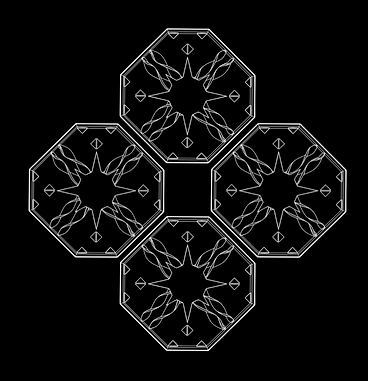
programmable metrics include:
Pre-existing Venue Lights
-
Beam angle and positioning
-
Light intensity
-
Colour
Because Kita's surfaces are mirrored and torsioned, small adjustments result in amplified spatial effects.
Kita installation
-
Speed of rotation twists
-
Direction of rotation
-
Which elements are active or dormant
-
Lighting Interaction